what is 3d printing or rapid prototyping.
What is 3D Printing?
3D printing is a layman term, the actual term is additive manufacturing or rapid prototyping. 3d Printing is the technology used for manufacturing of complex products in low quantity.
Why the term 3d?
3d denotes the three dimensions. Earlier printing technology is used for printing on papers. the printing done on papers have only 2 dimension I.e. only x and y means length and width.
Whereas in 3d printing process, printing is done in all the three dimension. How? basically in 3d printing process, printing is done only in 2 dimension i.e. x and y dimension in a single layer. But these layers are placed on top of each other to form the third dimension. I.e z dimension. Thus combining together they make 3d printing. In other words 3d printing is printing in 2 dimensions over and over to make the third dimension.
 Why 3d printing is revolutionary?
As compared to earlier conventional manufacturing, to make products in smaller quantity or for making prototypes, subtractive manufacturing is used.

Subtractive Manufacturing, image source http://krakenproject.eu
In subtractive manufacturing a big metal block is used and using various processes like drilling, milling, shaping etc. the desired product is made by remove materials from various positions of the blocks. Thus resulting in lot of material wastage and inability to make complex products.
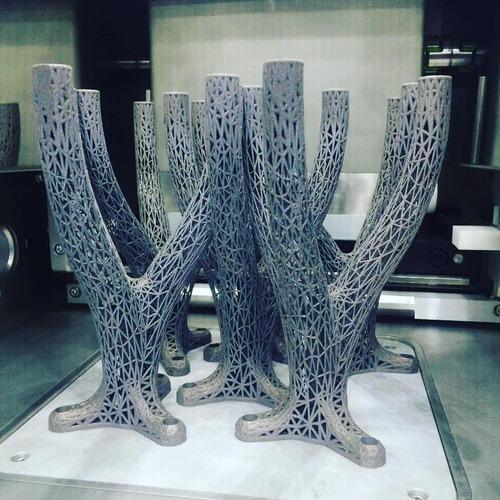
Whereas in 3D Printing manufacturing process, the material is deposited on only those positions
Image Source: www.extremetech.com/extreme/143552-3d-printing-with-metal-the-final-frontier-of-additive-manufacturing
where it is required, thus resulting in negligible material wastage and ability to make complex structures products without using moulds and sophisticated machineries.
When was 3d printing Invented?
3D Printing was invented in 1983 by Charles chuk Hull. Chuck invented the Stereolithography technology which used photopolymer resin as raw material and Ultraviolet rays for curing the resin.
UV light only cures those parts of the resin where the object has to be made. Thus making the object layer by layer.
Some wonders of 3d printing
-
3D Printed Car
Strati is the First ever 3D Printed car designed and manufactured by the company Local Motors.

The complete car is 3d printed by the 3D Printer in Just 72 hours. The Body of the car is 3D Printed using Fused deposition modelling FDM or FFF fused filament fabrication process. The engine, transmission and tyres are used from a golf cart. This car is completely electric and developed for showing the future and advantages of the 3d printing technology around the world.
-
3D Printed House
There are a various 3D printing technologies and materials used at construction industry, these include the following main methods: like extrusion (concrete/cement, wax, foam, polymers), powder bonding (polymer bond, reactive bond, sintering) and additive technology welding.

3D printing at a construction market will have a wide variety of applications within the commercial, private industrial and public sectors. Potential advantages of additive manufacturing technologies include faster construction, lower labor costs, increased complexity and/or accuracy, greater integration of function and less waste production.
-
Chocolate 3D Printing
Chocolate from ages viewed as an essential component of dessert. Since the starting, the focus was not just by putting chocolate on top of items, but making it in the form of intricate designs and shapes that make the entire dish look more attractive. In most of the regions, Chocolate making is defined as an Art.
But now, 3D printers allow users to choose from the library of uniquely designed delicious chocolate structures. Users can also create their original designs, uploading the design into the printer library, in much the same way that regular plastic models are created on 3D printers. This means users can even create a miniature model of themselves out of chocolate, show the model to their friends.
The major development that led to 3D printed chocolate printer was when researchers removed the plastic extruders found on regular 3d printers with syringe like extruders that carried chocolate paste with varying degrees of viscosity, depending on the type of chocolate to be made.
-
3D Printed Jewellery
The Jewellery production industry has embraced 3D printing rapidly. Many jewellers now use the technology to change the way things were done from past hundreds of years. 3D printing or additive manufacturing is now used to create the patterns for investment casting for the jewellery and to print jewellery directly.

There are several advantages of using additive manufacturing to produce jewellery. Some of them are:
• Ability of manufacturing Very complex designs: Earlier, jewellery casting patterns were carved/machined from wax using CNC machines or craftsmen. The process thus had very high limitations depending on the machinery and craftsmanship. Whereas, 3D printing is not restricted and is able produce parts that have in the past were impossible to make.
• Significant manufacturing time reduction: With additive manufacturing or rapid prototyping, multiple patterns can be made at once in a single shot run and within a very short time frame. This has significantly reduced lead times as well as cost.
• Mass Customisation: additive manufacturing also allows mass customisation i.e. multiple designs to be produced in a single print. This means it is very cost competitive pricing for low production volumes.
-
3D Printed Engine
People have used additive manufacturing or 3D printing to produce a long range of items — fidget spinners, prosthetic limbs, toys, even houses — but a new 3d printed engine sets a new bar for what can be achieved through additive manufacturing. More than a third of the components in GE’s advanced turboprop (ATP) engine, rated at horsepower of 1,300, will be built through additive manufacturing methods. The 3d printed engine will power Textron Aviation’s upcoming aircraft, the Cessna Denali.

Clearly Concluded, 3D Printing will revolutionise the way we make products slowly but steadily.
For more information related to materials and technologies follow Designifying Blogs
.